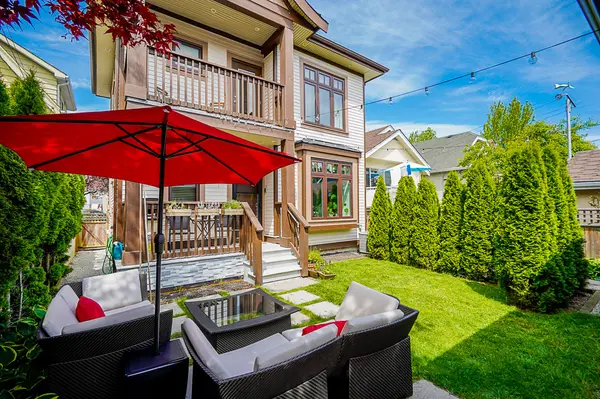
The North Shore Buyer's Complete Mortgage Guide for 2026
By Sasha Hahn | North Shore Buyer's Agent | sashahahn.com
For most North Shore buyers, the mortgage is the single largest financial commitment of their life — and it's one where small decisions can mean tens of thousands of dollars in savings or costs over time. Yet many buyers spend more time researching appliances than they do their mortgage product. This guide covers what you need to know to make a smart financing decision in 2026.
Where Rates Stand Right Now
As of early 2026, the mortgage rate environment on the North Shore looks meaningfully more favourable than it did at the peak of 2022–2023. The Bank of Canada implemented significant rate cuts throughout 2025, and today's lowest five-year variable rate in Vancouver is approximately 3.54%. Five-year fixed rates are currently in the 3.5%–4.0% range depending on the lender and your specific qualifying profile.
For context on what this means practically: on a $700,000 mortgage, the difference between today's rates and the 5.5% peak of 2023 is approximately $1,200 per month in payment savings. Buyers who were priced out at peak rates may find themselves back in range today.
Most forecasts suggest five-year fixed rates will remain roughly in the 3.8%–3.9% range through 2026, with potential for further modest decreases if economic conditions soften. Rates are not expected to return to the sub-2% levels of 2020–2021 — the era of historically ultra-low rates is behind us.
Fixed vs. Variable: Which Makes Sense in 2026?
This is the most common mortgage question buyers ask, and the honest answer is: it depends on your situation, your risk tolerance, and your timeline.
Fixed rate mortgages lock in your interest rate — and therefore your payment — for the term of the mortgage (typically 5 years). You know exactly what you'll pay each month regardless of what the Bank of Canada does. This predictability has real value for buyers who are stretching their budget or who sleep better with certainty. The trade-off is that if rates drop during your term, you're locked in at a higher rate unless you break the mortgage (which carries prepayment penalties).
Variable rate mortgages fluctuate with the Bank of Canada's overnight rate. When the Bank cuts rates, variable mortgage holders see their rates decrease (and either their payment drops, or more of their payment goes to principal). When the Bank raises rates, the opposite happens. In 2025, variable rate holders benefited from a series of Bank of Canada cuts. The risk is that if rates rise again, your carrying cost rises with them.
In 2026, with rates having already come down significantly and forecasts suggesting a more stable environment ahead, the gap between fixed and variable is relatively narrow. Most buyers in Sasha's experience are opting for fixed rates for the peace of mind — but buyers with financial cushion and a longer risk horizon may find variable rates compelling.
The Stress Test: What It Means for North Shore Buyers
Canada's mortgage stress test requires all borrowers to qualify at a rate that is the greater of 5.25% or their contracted rate plus 2%. In practical terms, with today's rates in the 3.5%–4.0% range, most buyers are being stress tested at approximately 5.5%–6.0%.
What this means: you need to demonstrate that you could afford your mortgage payments at those higher rates, even though your actual payments will be lower. For North Shore buyers, this is a real constraint — the combination of high property prices and the stress test means that qualifying for a mortgage on a $900,000 condo requires significantly higher household income than the payment alone might suggest.
On a $720,000 mortgage (80% of $900,000) stress tested at 5.75%, you need to qualify for payments of approximately $4,450 per month, which generally requires a gross household income in the range of $180,000–$200,000+ depending on debt load and other factors. These numbers explain why many first-time North Shore buyers are purchasing as couples or with family support.
Mortgage Brokers vs. Banks: Which Should You Use?
This is a genuine question worth thinking about carefully. Both have their place.
Banks and credit unions where you have an existing relationship may offer competitive pricing and a streamlined process. If you've been a loyal customer and have a strong financial profile, your own bank is worth approaching first.
Mortgage brokers have access to a broad panel of lenders — chartered banks, trust companies, monoline lenders, and credit unions — and can shop your application to find the most competitive rate and terms for your specific profile. In a market where lender pricing varies meaningfully, this access has real value. Brokers are also particularly helpful for self-employed buyers, buyers with non-traditional income, or buyers who don't qualify under standard bank criteria.
For most North Shore buyers, getting a quote from both your own bank and a mortgage broker — and comparing apples-to-apples — is the most pragmatic approach. Don't just compare the rate; compare prepayment privileges, penalties for breaking the mortgage early, portability (the ability to transfer the mortgage to a new property), and assumability.
Down Payment Strategies for North Shore Buyers
The minimum down payment in Canada is 5% on homes up to $500,000 and 10% on the portion between $500,000 and $999,999. On a $875,000 condo, the minimum down payment is roughly $62,500 (5% of $500,000 + 10% of $375,000 = $25,000 + $37,500).
However, putting down less than 20% requires you to purchase mortgage default insurance (CMHC, Sagen, or Canada Guaranty), which adds a premium of 2.8%–4.0% of the mortgage amount to your total loan. On a $812,500 mortgage (93% of $875,000), a 4.0% CMHC premium adds $32,500 to your mortgage — which you then pay interest on over the life of the loan. The true cost of a small down payment is significantly higher than it appears.
A 20% down payment ($175,000 on $875,000) eliminates the default insurance requirement and meaningfully reduces your total borrowing cost. Buyers who can stack FHSA, RRSP HBP, and personal savings to reach 20% will be in a substantially stronger financial position over the life of the mortgage.
Pre-Approval vs. Pre-Qualification: Know the Difference
A pre-qualification is an informal estimate of how much you might be able to borrow based on unverified information you provide. It typically takes 10 minutes and involves no document review. It is essentially meaningless in a real estate transaction.
A pre-approval is a formal credit review where the lender assesses your verified income (T4s, NOAs, pay stubs), assets, debt obligations, and credit score. A genuine pre-approval comes with a written letter confirming your borrowing limit and a rate hold for 90–120 days. This is what you need before you start seriously looking at North Shore properties.
Many buyers are surprised to discover that their pre-qualification estimate and their actual pre-approval are quite different numbers. Get the pre-approval done early — ideally 60–90 days before you want to start writing offers — so you have time to address any issues that come up.
Sasha Hahn works closely with her buyers' mortgage professionals as a standard part of the purchase process, and can refer buyers to trusted mortgage brokers with specific North Shore experience. Visit sashahahn.com to get started.
FAQ
What mortgage rate can I get in Vancouver in 2026? As of early 2026, five-year variable rates start around 3.54% and five-year fixed rates are roughly in the 3.5%–4.0% range. Your specific rate will depend on your credit score, income, down payment, and which lender you qualify with.
How much income do I need to buy a condo in North Vancouver? It depends on the purchase price and your down payment. For a $875,000 condo with 20% down, you'd typically need a gross household income of approximately $180,000–$200,000+ to pass the stress test, depending on existing debt obligations. A mortgage broker or bank can give you a precise qualifying amount based on your actual numbers.
Can self-employed buyers get a mortgage for a North Shore property? Yes, though the process is more involved. Self-employed buyers typically need to document 2 years of income through NOAs (Notice of Assessments) and business financials. A mortgage broker experienced with self-employed buyers can identify the right lender product for your profile.
Is it worth breaking my current mortgage to buy on the North Shore? This depends on your existing mortgage rate, the prepayment penalty, and the rate differential you'd gain by refinancing. In a period where rates have come down, some buyers do benefit from breaking and refinancing — but the math needs to work specifically for your numbers. Your mortgage broker can model this clearly.
Categories
Recent Posts